
History
Key Curriculum Information
History Long Term Plan and Curriculum Progression
Intent of History at Woodlands
At Woodlands, we want history to be meaningful, relevant and engaging for all our pupils. Our history curriculum helps children make sense of the world around them by developing their understanding of the past and how it has shaped life today. Through learning about people, events, places and changes over time, pupils begin to understand that the world they live in has a history and that their own lives are part of a wider story.
A high-quality history education builds a sense of identity, community and belonging by exploring the lives of people in our local area and beyond. It helps pupils understand how and why things change over time, why some people and events are remembered and how we find out about the past. At Woodlands, we want pupils to become curious, thoughtful and reflective learners who are able to talk about the past, using growing historical knowledge and vocabulary.
Our history curriculum begins in the Early Years, where pupils develop a sense of time through stories, vocabulary such as ‘past’ and ‘present’, and by exploring changes in their own lives and families. These foundations support the development of historical thinking in Key Stage 1, where pupils begin to investigate significant events and aspects of the past, whilst beginning to use sources and evidence to ask and answer questions.
Through rich and purposeful enquiry, we want our pupils to:
- Build knowledge of key events, people and places from the past
- Use sources, artefacts, images and other sources to ask questions and explore the past
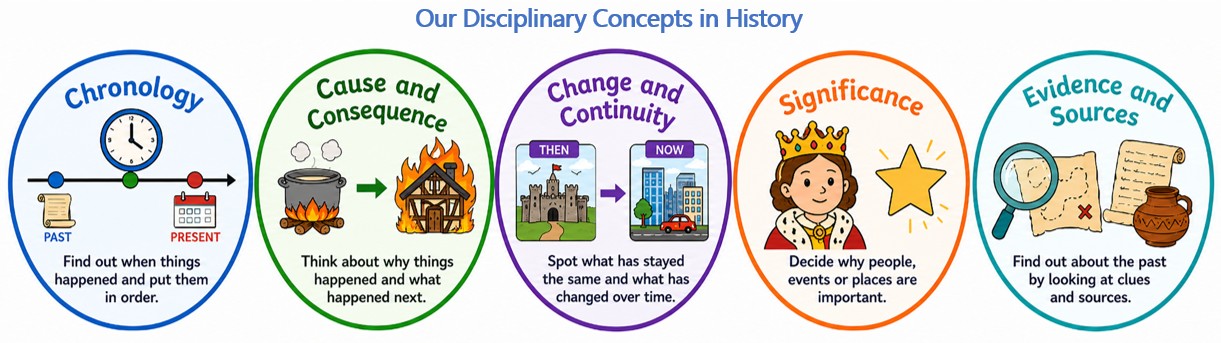
- Develop an understanding of chronology, cause and consequence, change and continuity, significance and evidence and sources
- Connect their own lives and community to wider local, national and global histories
- Develop confidence in speaking, reasoning and explaining their ideas as young historians
Our history curriculum is rooted in our school values of Belief, Respect, Independence, Curiosity, Creativity and Kindness. It reflects our local context, is shaped by what we know about our children and community, and lays the foundation for future historical learning beyond Key Stage 1.
Why History matters to our pupils
- Many of our pupils are new to formal learning and need grounding in basic concepts of time and change.
- Learning about the past helps children understand their identity and heritage.
- Local figures and places provide meaningful connections to historical learning.
How our History curriculum is bespoke to Woodlands and reflects our context and values
- It is meaningful and relevant, starting with what children know best – themselves, their families, their school and their local area, before broadening to include significant people, events and changes beyond immediate experience.
- We draw on people, places and stories that connect to our community (e.g. Cecil Aldin, Jack Grealish, George Cadbury) to make learning relevant. Our pupils see history rooted in the places that they know.
- Our choice of themes and enquiries also reflects our school values. reflects our school values. Through history, children learn about courage, change, achievement, remembrance, community and fairness.
- The curriculum supports speaking and listening development and vocabulary acquisition.
- The curriculum is designed to be inclusive, engaging and accessible to all pupils, with rich opportunities for talk, storytelling, role-play, visual prompts and practical experiences.
Key Disciplinary Concepts in our History Curriculum
We want our pupils to think and work like a historian. To do this, they need to:
- Put events in order (Chronology)
- Think about why things happened (Cause and consequence)
- Spot what is the same and different (Change and continuity)
- Decide why something or someone is important (Significance)
- Find out about the past (Enquiry, evidence and sources)
Substantive Themes in our History Curriculum
In History, substantive knowledge refers to the people, events, places, experiences and themes that pupils study. At Woodlands, this knowledge is organised into seven recurring themes which are revisited and developed from Nursery to Year 2:
- Homes and Housing
- Travel and Transport
- Local History
- Exploration
- Toys and Play
- Famous People
- Conflict and Peace
These substantive themes are carefully sequenced so that pupils revisit ideas in increasing depth and with growing historical understanding. They allow children to make connections over time, build secure knowledge and deepen their understanding of how people lived, what changed and why this matters. Detailed progression is set out in the History Long Term Overview and Skills Progression document.
How learning deepens from EYFS to Year 2
In the Early Years, history is rooted in children’s own experiences, familiar stories and early language about time and change. Children begin by talking about themselves, their families, special events and things that happened before. Through stories, pictures, objects and discussion, they begin to notice differences between now and the past and develop a simple sense of chronology. Historical learning at this stage is practical, language-rich and closely linked to children’s own world.
In Key Stage 1, these early foundations become more structured and explicit. Pupils begin to study significant people, events and aspects of the past beyond living memory. They use a growing range of vocabulary, place learning in sequence, make comparisons and begin to use evidence and sources more deliberately. Enquiry becomes more focused, with pupils asking and answering questions about what happened, why it happened and why it is remembered.
From Year 1 to Year 2, pupils’ historical understanding deepens further. Their chronological awareness becomes more secure, their comparisons become more thoughtful and their explanations become more detailed. They begin to draw more deliberately on prior learning, connect ideas across topics and explain historical significance with greater confidence. By the end of Year 2, pupils have developed strong foundations as young historians and are ready to build on this in Key Stage 2.
How progress is assessed and evaluated
We have clear age-related expectations for each year group, supported by our progression in disciplinary and substantive knowledge. Teachers assess pupils’ learning through discussion, questioning, story retelling, role-play, drawing, sequencing activities, use of sources, vocabulary and recorded outcomes. Assessment is ongoing and is used to inform future teaching and revisit key knowledge where needed.
Progress is seen not only in what pupils know about the past, but in how they think historically. Over time, pupils show increasing confidence in using historical language, ordering events, making comparisons, asking questions, drawing on sources and explaining why people or events are important. Pupil voice, books, classroom evidence and teacher observations help us capture this development over time.